
The Botanical Archive · 东方芳香档案
Angelica Root, Patchouli and Chenpi: An Apothecary Scent
Angelica root is warm, earthy and distinctly herbal in AN’s scent vocabulary, with the impression of dry roots and woody depth. Here, angelica means Chinese danggui, Angelica sinensis (当归), rather than every plant sold under the English name “angelica.” Alongside patchouli, it recalls the concentrated herbal character of a Chinese apothecary; chenpi brings a citrus edge that rounds the medicinal scent.
First, which angelica?
In 芳香中药学, danggui is the dried root of Angelica sinensis, a plant in the Apiaceae family. The plant name identifies a species; “root” identifies the part discussed. Neither tells us exactly how a particular extract or finished fragrance will smell.
Kew recognises Angelica sinensis and Angelica archangelica as separate species. That distinction matters when reading English fragrance descriptions. An account of another angelica species, or of its seed rather than its root, should not be used as a description of Chinese danggui. This archive entry concerns A. sinensis, the identity confirmed by AN for its angelica reference.
Danggui in Chinese herbal tradition
Traditional classification. The textbook classifies danggui as 甘、辛、温: sweet, pungent and warm. It associates it with 肝、心、脾, conventionally translated as the Liver, Heart and Spleen channels. These are categories within Chinese materia medica; they do not describe where fragrance travels in the body.
The entry includes 补血 and 活血 among its traditional functions: concepts often translated as nourishing and moving blood. They belong to a historical medicinal framework. They are not evidence that an angelica fragrance affects circulation, nor are they claims about an AN candle.
For the archive, the useful distinction is between this inherited vocabulary and a contemporary olfactory reading. “Warm” in materia medica is a traditional classification. Warmth in a fragrance description is a sensory impression. The words can prompt a creative association without becoming equivalent claims.
Patchouli: a meeting point between perfumery and Chinese materia medica
Patchouli is 广藿香 (guanghuoxiang), Pogostemon cablin. Hong Kong Baptist University’s medicinal-material database identifies the traditional material as the plant’s dried aerial parts. Its place in Chinese herbal practice sits alongside its familiar role in perfumery: in AN’s composition, its earthy, woody character deepens the impression of roots and stored herbs.
There is a specific cultural connection here. 广藿香油, patchouli oil, is listed among the ingredients of 藿香正气水 (Huoxiang Zhengqi Shui), the Chinese medicinal preparation; chenpi is also listed. For someone familiar with Chinese herbal preparations, these names may carry a strong aromatic memory. That connection helps explain the apothecary character AN seeks, without suggesting that a candle reproduces the medicine or its effects.
Chenpi is part of this composition
AN confirms that No.2A uses 陈皮, chenpi. The name deserves to remain visible: translating it simply as “citrus” would lose the identity of the material. In 芳香中药学, chenpi is the dried mature peel of Citrus reticulata and its cultivated varieties. The entry discusses the traditional value placed on aged peel; AN does not specify a storage age here.
The textbook classifies chenpi as 辛、苦、温: pungent, bitter and warm, and records 理气健脾、燥湿化痰 within its traditional framework. Those medicinal categories explain the material’s place in Chinese herbal literature. In this fragrance, the relevant quality is its peel-like citrus character and the way it meets the deeper herbal notes.
配伍: the relationship between the materials
AN’s olfactory interpretation. Angelica root and patchouli form a distinctly medicinal-smelling centre: dry herbs, earthy roots and the memory of a Chinese apothecary. This character is substantial and intentional. Chenpi and the surrounding citrus brightness round its edges, allowing that herbal character to remain present within a fuller fragrance.
We use 配伍 (peiwu), the arrangement of materials in relation to one another, as a way to discuss the composition. In Chinese medicine, the word concerns combinations within a medicinal framework. Here, AN adapts the idea to scent: what each material contributes, how another changes its impression, and how the whole comes together. GROUND is a contemporary fragrance composition, not a reconstruction of Huoxiang Zhengqi Shui or an attributed classical prescription.
In perfumery terms, the contrast is between earthy depth and citrus brightness. In a Chinese aromatic context, the same materials carry the familiarity of an herbal cabinet. Both readings help explain this scent. A related contrast appears in perilla leaf and lemon, where citrus gives a green leaf a sharper outline.
The modern translation: No.2A GROUND
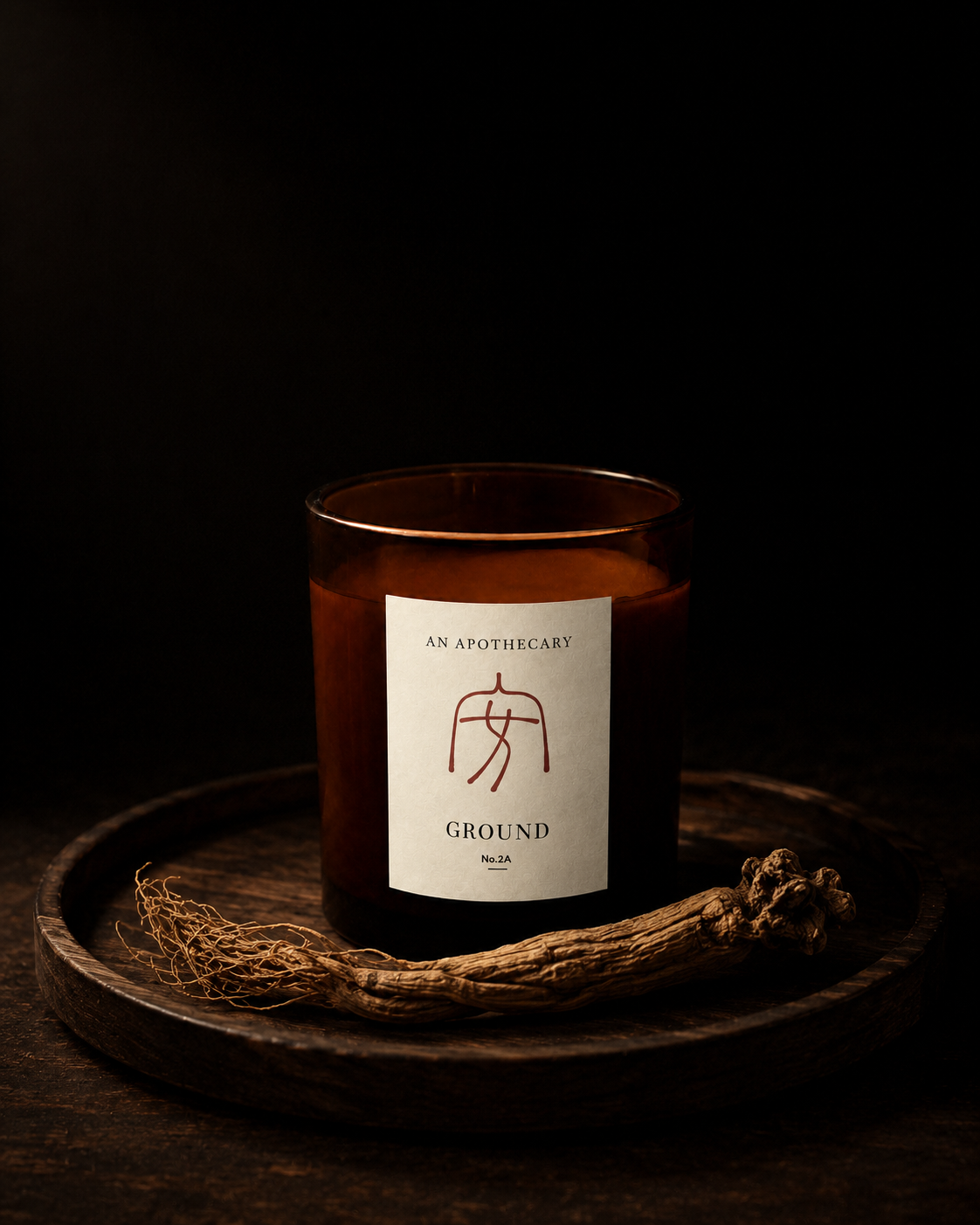
Angelica root, patchouli and chenpi are central to this account of GROUND, with cedarwood extending its dry woody structure. AN describes a pronounced Chinese-apothecary aroma, balanced by chenpi and citrus. These are the materials and relationships that define its character; this account does not specify proportions or a complete manufacturing formula.
If you are drawn to the scent of Chinese herbal shops, or curious about the aromatic materials encountered in TCM formulas, GROUND offers a fragrance-led way into that world. The medicinal quality is part of its appeal. “Medicinal” here describes the smell: it does not promise a health benefit.
The name GROUND reflects the weight of roots, earthy patchouli and dry woods in this arrangement. Chenpi gives that weight a brighter contour. This is AN’s sensory interpretation of the name, and the reason this particular combination belongs in the archive.
A tangible afternoon
When the afternoon begins to scatter, clear one surface and return one object to its place. Let a small physical action give the next part of the day a beginning. If fragrance belongs in that room, GROUND can accompany it: a warm root-and-wood presence with space around its edges.
Explore No.2A GROUND. For the wider approach, read Our Method.
Questions from the archive
Is Chinese angelica the same as every angelica used in perfume?
No. Chinese danggui is Angelica sinensis. Other species, including Angelica archangelica, have their own identities. A shared common name is not enough to transfer a scent description between them.
Should dried danggui smell exactly like GROUND?
No. A dried root, a fragrance material and a finished candle are different things to smell. GROUND is a composition containing other scent elements; its description should not be treated as a reference standard for the raw herb.
Does GROUND contain chenpi?
Yes. AN has confirmed that No.2A GROUND uses chenpi (陈皮). Its citrus character helps balance the pronounced herbal scent of angelica root and patchouli. No specific aging duration is claimed.
Source notes
- Traditional materia medica: 熊磊、赵毅、解宇环主编,《芳香中药学》,中国中医药出版社,2022. 当归, printed pp. 250–251; 陈皮, pp. 142–143. These support identity and traditional classifications, not candle efficacy or a historical recipe for GROUND.
- Botanical identity: Royal Botanic Gardens, Kew, Angelica sinensis and Angelica archangelica, Plants of the World Online.
- Patchouli identity: Hong Kong Baptist University, Guanghuoxiang medicinal-material record.
- Formula context: Beijing Administration of Traditional Chinese Medicine, 藿香正气水这些功效 您知道吗?, 28 July 2022. Its ingredient list includes patchouli oil and chenpi; this is a source for the medicinal preparation, not for candle efficacy.
- AN interpretation: current GROUND product description and AN’s material and scent clarification on 24 September 2026, including chenpi and the pronounced apothecary character. The pairing argument and sensory language are AN’s interpretation. The textbook, its editors and publisher do not endorse AN Apothecary.